
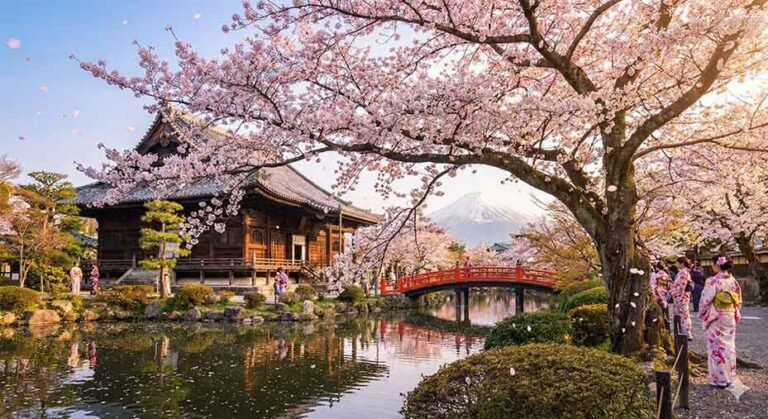

Let's be honest: one of the reasons people book a flight to Japan in spring is to take that perfect photo under a cloud of pink petals. Cherry blossom season, or Sakura, is an event so powerful that it can send an entire nation into a tailspin. Cherry Blossom, But it's not just a walk in the park: it's a race against time. Flowers bloom, enchant, and fall in a matter of days. If you want to avoid traveling halfway around the world to find only bare branches and brown petals on the ground, you absolutely need a strategy.
1. Use dedicated apps, the Japanese are crazy about them!
Let's leave the romantic image of the wise man sniffing the air to predict flowering to the movies. Today, Sakura Zensen (the flowering front) is followed with the precision of a surgical operation.
To move like a “local”, you can download Sakura Navi. This app doesn't just give you a vague date, but shows you the exact percentage of bud opening in real time. It notifies you if you pass by a scenic spot and lets you "collect" the places you've visited like a digital passport.
If you want an even more direct approach, Weather News It is based on photos uploaded by users: it is the best way to know if in that At this very temple in Kyoto, the flowers are at their most beautiful this morning.
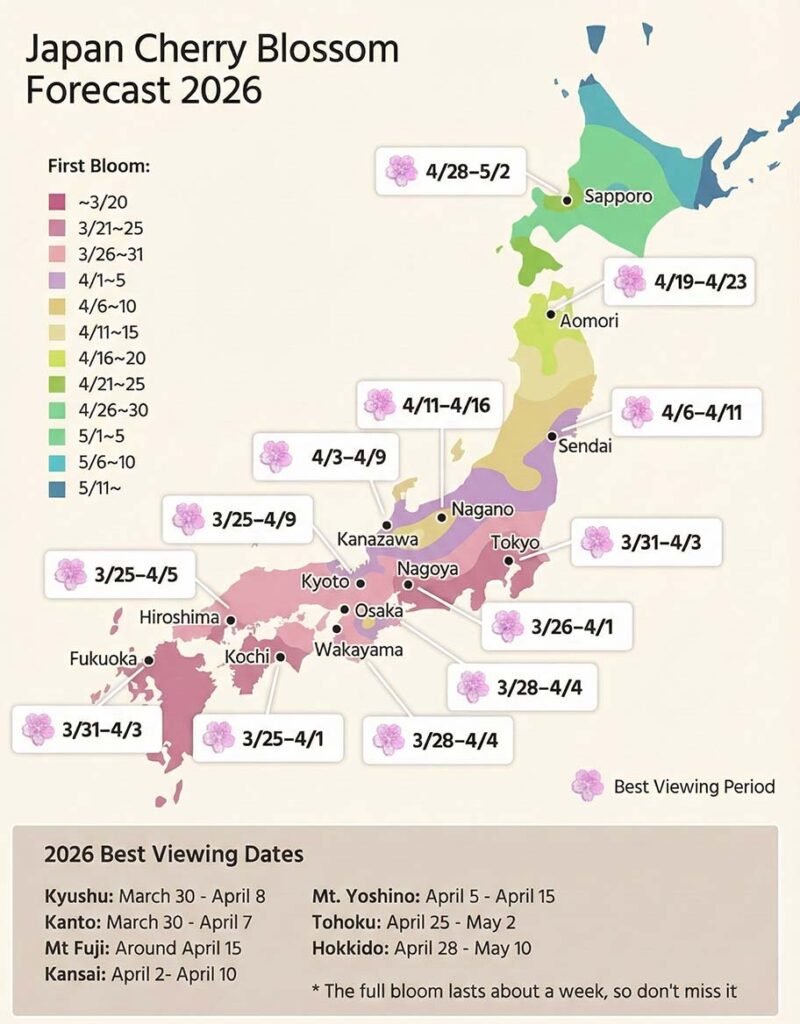
The tactical calendar for 2026
Dates may vary with the weather, but these are the essential coordinates to intercept the perfect moment:
2. Why do Japanese people love what falls?
For us Westerners, a flower is beautiful while it lasts. In Japan, the cherry tree is revered precisely because Not hard. It is the concept of the Mono no AwareThe poignant beauty of ephemeral things. The cherry blossom falls at its peak, unfading from the branch. For the samurai, it was the symbol of the ideal death: departing in full force, with grace and without regret.
This poetic philosophy clashes with corporate reality today. If you walk through a park at dawn and see a single person sitting on a huge blue blanket, you're witnessing a rigid social tradition. It's almost always the youngest recruit in the office, sent there in the cold to physically occupy the best seat while waiting for the bosses to arrive in the evening for the sake banquet. But I don't know if I'd call it mobbing; I'd say there are much worse things.
3. Amazing Stories (and Where to Find Them)
Beyond aesthetics, there is an almost magical side to these trees that few people know about.
- The astronaut cherry tree: In Yamanashi there is the Jindai Zakura, a venerable tree nearly 2,000 years old. Some of its seeds were taken to the International Space Station. Upon their return to Earth, they sprouted and grew at a rate science still can't fully explain.
- The Nursery Tree: A legend tells of a nurse who offered her life to the gods to save the child she was caring for. The tree planted in her memory, the’Ubazakura, blooms on the anniversary of her sacrifice and its flowers have a particular shape that recalls the mother's breast.
- The Soul of the Samurai: It is said of an old warrior who outlived all his loved ones. The day his beloved cherry tree died, he committed seppuku (ritual suicide) right down there. It is said that his spirit entered the trunk, causing the tree to bloom every year on the day of his death, braving even the January frost.
4. Where to go to avoid the crowds
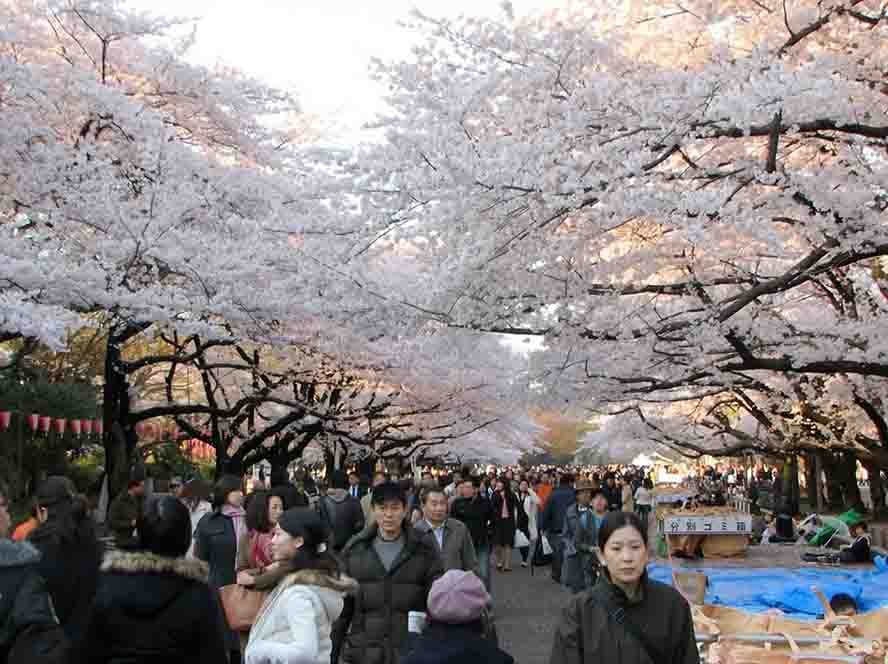
While everyone is crowding in Ueno or to Philosopher's Path, you can aim elsewhere.
- Total immersion: Haradani-en (Kyoto)
Forget public transportation; you can get here by taxi or rental car. It's a private garden where weeping cherry trees (shidarezakura) create tunnels so dense it feels like swimming in a sea of pink. It's the perfect place to eat a bento on a bench hidden among the petals, away from the chaos. - The optical illusion: Bishamon-do (Kyoto)
Famous for the centuries-old cherry tree that covers the entrance like an umbrella, this temple hides a secret inside: the fusuma paintings, which, thanks to a reverse perspective technique, appear to move and follow you as you walk around the room. - The urban night: Nakameguro (Tokyo)
A must-see after sunset. The canal transforms into a tunnel of pink lanterns reflecting on the dark water. Among steaming skewers and glasses of rosé champagne sold on the street, this is where you can experience the most vibrant atmosphere of modern Tokyo.
5. Three ready-to-use itineraries
Here's how to structure your trip based on what you're looking for:
- The Pink Pilgrimage (Spirituality)
Start from Mount Koya, sleeping in a monastery, and continuing to Mount Yoshino. Here the spectacle is vertical: 30,000 cherry trees climb the mountain slopes like a rising wave. The view from above repays all the effort. Once you see this spectacle, it will be easy for you to understand why Mount Koya is sacred and imagine it as the guardian of the Kami.
- The Second Chance (For Latecomers)
If you arrive late for Tokyo, point your compass north towards Hirosaki (Aomori). Here, the fallen petals completely fill the castle moat, creating a solid "pink river" that feels like walking on it. With the still snow-capped mountains in the background, it's a unique scene.
- Secret Kyoto (Relax)
Avoid the crowds at the main temples. Rent a car to explore the outlying gardens or enjoy a canal cruise. Fushimi on board traditional boats Jikkokubune. Gliding on the water under the willows and cherry trees, perhaps after a visit to the local sake distilleries, is pure poetry.
Do you want to leave without stress?
Planning a trip to Japan during Sakura can seem like a logistical headache, with sky-high prices, weather forecasts, full hotels, and language barriers.
At Lechuguita, we can design your tailor-made itinerary, book the right restaurants, and guide you day by day toward the perfect bloom.
👉 Contact us here to start planning: Lechuguita – Your Tailor-Made Trip
Happy flowering! 🌸