
Our invitation
A trip to Hokkaido, if undertaken with awareness, ceases to be tourism and becomes an immersive dialogue between local history, culture, and traditions. Our invitation is to encourage authentic travel, preserving the beauty and diversity of our world, abandoning the obsessions of social media, slowing down, and perhaps rediscovering a little bit of yourself in these confusing times, far removed from the rhythms of humanity and all living things.
The rediscovery of hidden itineraries and stories is central to us, in travel as in life. Every moment we experience will never return, but it can live on in our memories and emotions.
At the bottom of the article you'll find several travel tips to discover Japan's hidden beauties!
The Children of the Earth and the Snow
This is the story of a forgotten people, an enigma trapped for millennia in the forests of the Japanese archipelago.
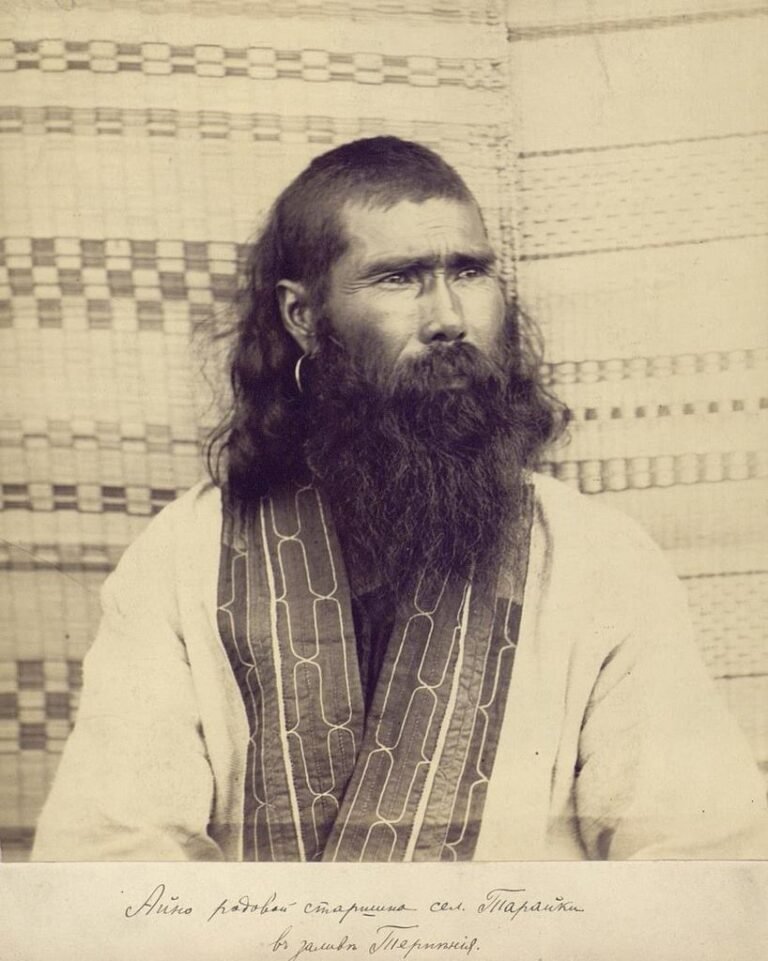
Over the centuries, travelers and anthropologists who ventured into Japan's far north have faced a puzzle. Among the snows of Hokkaido lived the Ainu, a deep-eyed people whose physical features did not resemble those of their Japanese neighbors. Their lighter skin, as well as their often blue or green eye color, their stocky build, and the widespread body hairiness of their men, led early observers to classify them as "Caucasian.".
It was asked how a people with apparently "Western" characteristics had ended up isolated in the Japanese archipelago well before the arrival of the Asian phenotype, the Wajin.
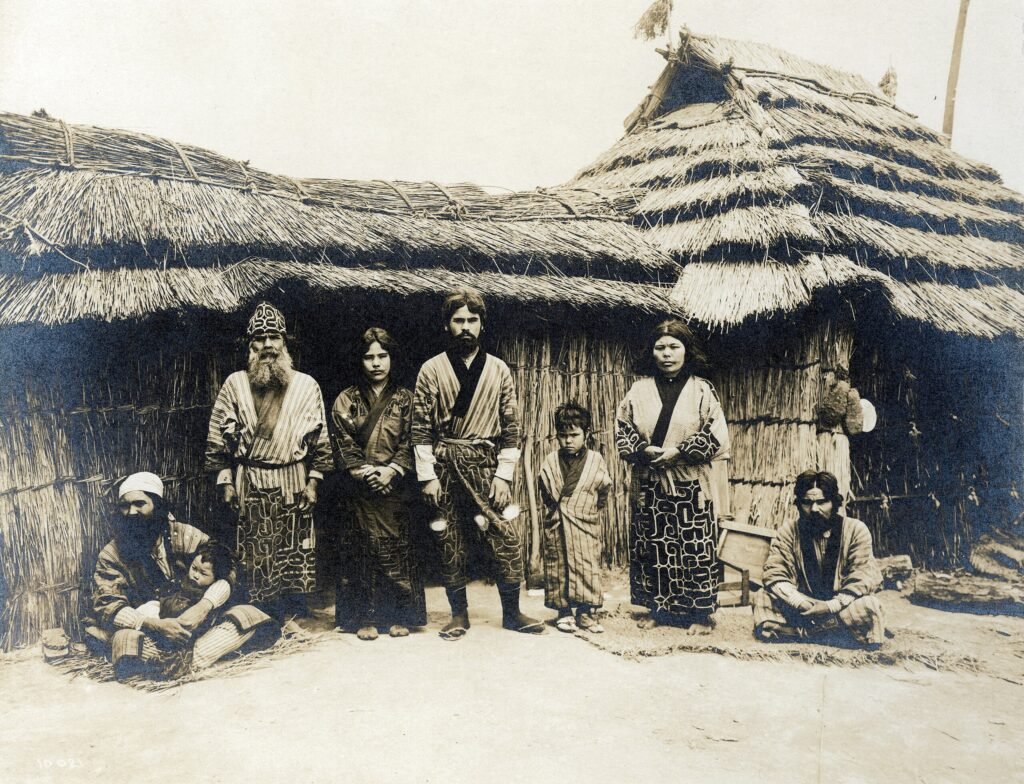
Men wore thick, magnificent beards that reached down to their chests. Women adorned their mouths with distinctive tattoos that accentuated their features and warded off evil spirits.
These men and women seemed to have stepped out of a Russian, Indian, or even European legend, and yet there they were, isolated on an island at the edge of the world.
The truth, as often happens, is more fascinating than theories. The Ainu were not foreigners from afar. They were the very roots of the archipelago. They are the direct descendants of ancient peoples who walked those lands tens of thousands of years before the very concept of "Japan" was born. Their myths tell us that they came from nowhere: they were born from the earth itself, with bodies made of soil and hair of grass, an ancient and precious genetic mosaic that has survived time and isolation.
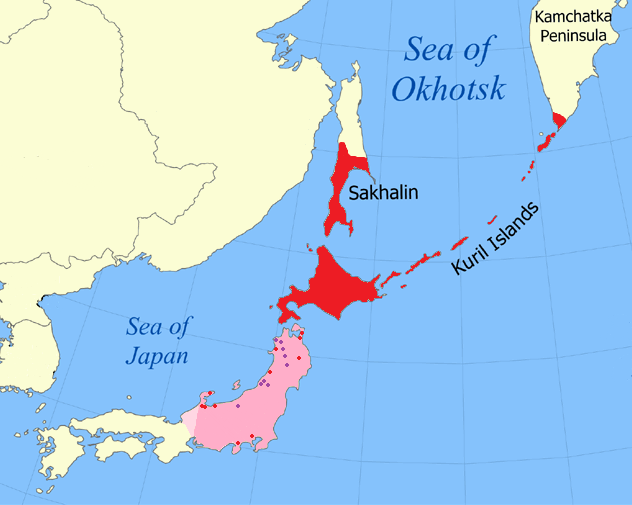
Their territory extended far beyond the island of Hokkaido (then known as Ezo); it also included the southern part of Sakhalin and the Kuril Islands. For centuries, they lived as a hunter-gatherer and trader society.
The Shadow of Silence
The beauty of this uniqueness was in danger of fading forever. With the arrival of modernization, a long, cold shadow fell on the "Land of Men" (for them the“Ainu Moshir). What followed was a story we unfortunately know well, a story of borders drawn on maps without asking permission from those who inhabited those lands.
The first contacts with other populations were commercial, but with the expansion of the Wajin To the north, relations became strained. As early as 1457, the Koshamain Rebellion marked one of the first major armed conflicts between the Ainu and the Japanese settlers settling in southern Hokkaido.
The Ainu were animists, believing that every element of life was sacred and embodied by a god (the Kamuy). They believed in the balance of all things. Every element of nature, every artifact, every atmospheric agent carried within it the gift of the gods, and was to be celebrated in its entirety with gratitude.
They were told that their way of life, based on hunting and interacting with nature, was wrong. They were told to shave off their sacred beards, to stop tattooing women's lips. They were told to forget the language of their fathers, a musical idiom that had no written form because it lived in breathing and in stories told around the fire, their direct connection to the afterlife.
They were told to join the Wajin, forcing women to have children with the newcomers.
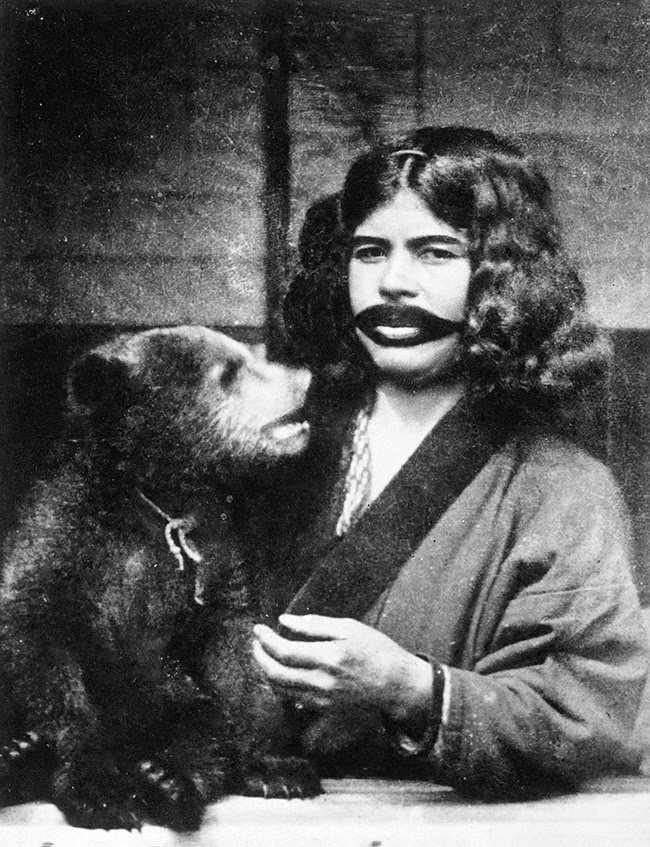
The irreversible turning point came with the Meiji Restoration in the late 19th century. The new Japanese imperial government, eager to modernize the nation and consolidate its northern borders (particularly against the perceived threat from Russia), formally annexed the archipelago's largest northern island, renaming it Hokkaido.
To “develop” Hokkaido according to the agricultural model Wajin, the Ainu way of life, based on hunting, fishing and gathering, was to be eradicated.
A massive migration of settlers began Wajin on the island. The Ainu, once masters of their land, quickly became a minority. The figures are shocking: the percentage of Ainu in Hokkaido's total population plummeted from 151 TP3T in 1873 to a paltry 0.51 TP3T in 1936.
For nearly a century, being Ainu became a shame, something to be hidden. Many stopped telling their children the old stories to protect them, hoping they would blend in with the crowd, becoming "invisible" to survive. The people who worshipped the bear as a god found themselves caged, sadly labeled a "primitive and dying race.".
The Return of the Voice
Yet something has survived beneath the snow. Like seeds patiently awaiting the end of winter, Ainu culture has not died. It has slept. And today, it is sprouting with a new, slow but inextinguishable strength.
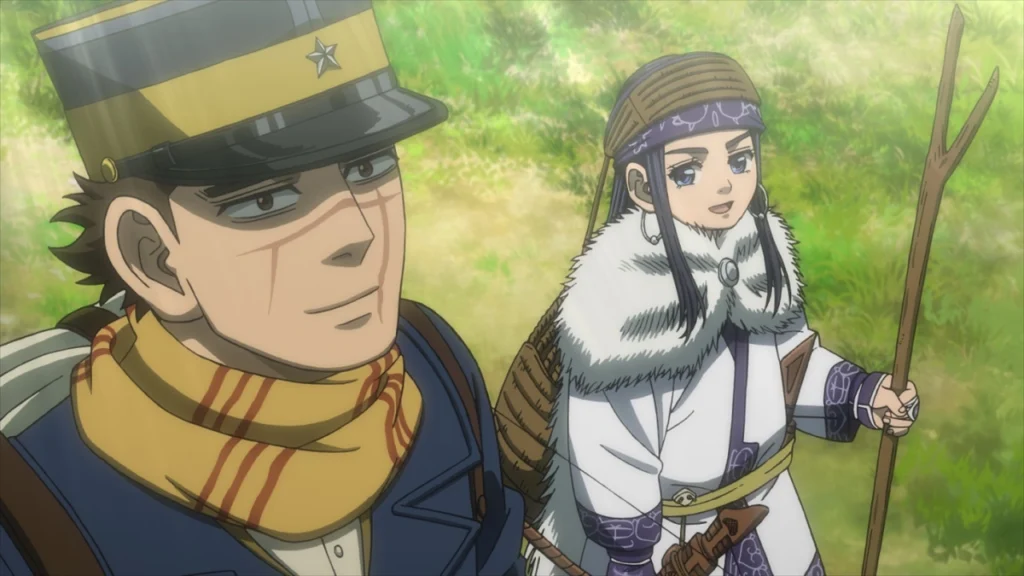
Today, if you listen carefully, you will hear the sound of the tonkori, a long, flat, five-stringed harp, traditionally made from deer tendons, originating from the Ainu of Karafuto (Sakhalin Island). Artists like OKI have revived this instrument to reclaim their name, their art, and their pride, finding new forms of expression suited to the present day. Even comics and cartoons, like the famous Golden Kamuy, helped tear the veil, making millions of people fall in love with a courageous Ainu girl and her traditions.
Experiencing the Spirit World: The Kamuy
To truly understand who the Ainu are, and why we want to take you on these particular routes in our travels, we must first explain the Kamuy.
For the Ainu, the world is not made of "things" or "resources." Everything is alive. Everything has a spirit. The fire that warms the house is not a chemical reaction, but is Kamuy Fuchi, the grandmother of the hearth, a goddess who protects the family. The owl that watches over the night is the protector of the village. The bear is not prey, but a mountain god who donned a fur coat to visit humans and offer them its flesh in exchange for respect and prayers.
There is an Ainu proverb that encapsulates this vision with disarming simplicity: “Kanto orowa yaku saku no arankep shinep ka isam”. It means: “Nothing in this world exists without a role”.
In an age when we often feel disconnected from nature and others, this philosophy is healing for the soul. It teaches us that we are not masters of the earth, but guests in a sacred world, where every encounter deserves gratitude.
The Fabrics: Attus and Chikarkarpe
Traditional Ainu clothing, exhibited in museums around the world, immediately captures the eye with its bold and elegant geometric beauty. These garments were made primarily using two techniques.’ actus It was a strong, durable fabric, spun and woven from the inner bark of the elm tree (attush). The chikarkarpe (which means “our embroidered things”) was instead a dress, often made of cotton obtained through trade with the Wajin, on which intricate embroidery was applied.
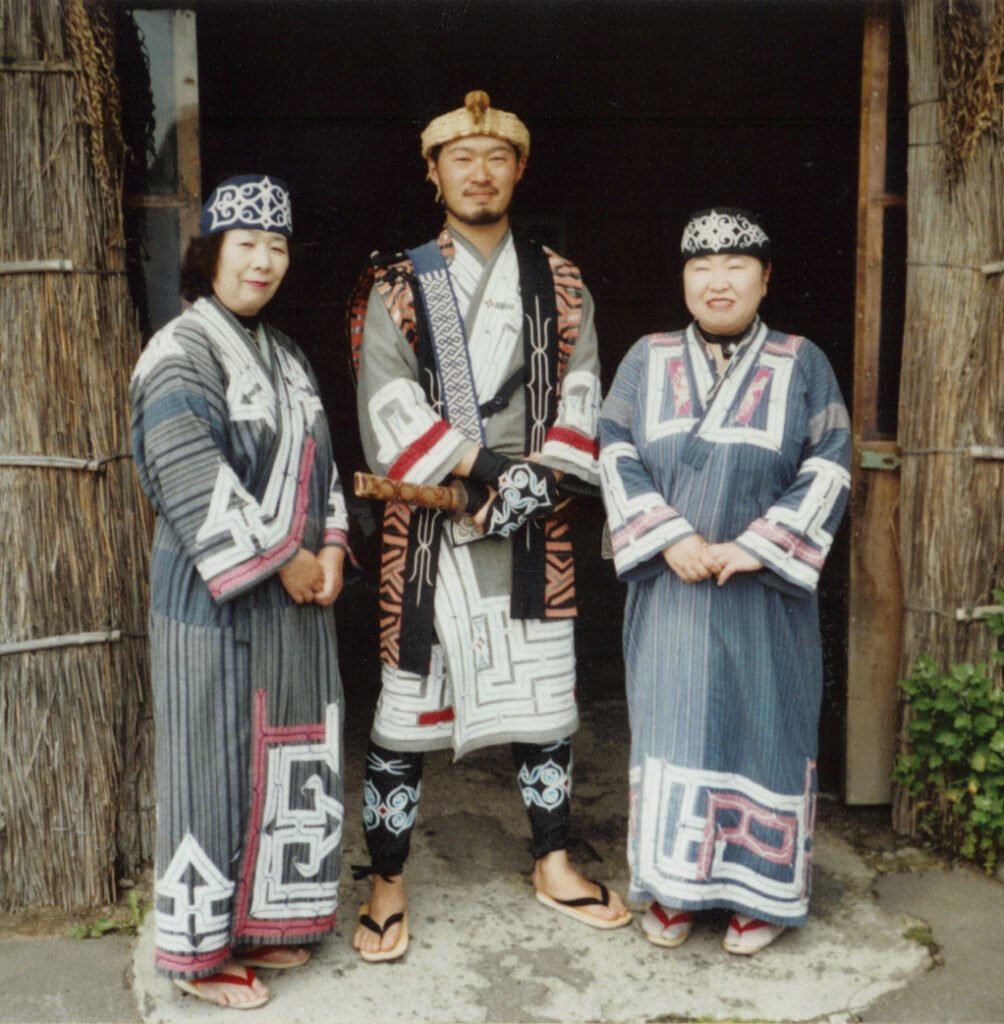
The aesthetics of these clothes is a direct expression of the worldview kamuy. The curvilinear and geometric motifs were not simple ornaments, but powerful protective talismans. Specific motifs, such as ay-us-sirki (“thorns”) and sik-sirki (“eyes”), were carefully and intentionally sewn around the openings of the garment (neck, cuffs, hem). These pointed, “vigilant” designs were believed to keep evil spirits away (wen kamuy) to enter the body and bring misfortune or illness. Wearing an Ainu dress meant wrapping oneself in spiritual armor.
The Engraving: Iku-pasuy and the Personal Universe
Similarly, wood carving, a predominantly male domain, was imbued with spiritual significance. The most emblematic object is the’iku-pasuy (or ikupasuy), a flat, finely carved “prayer stick.” This ritual tool was essential for communication with the kamuy. It was used to raise the sake cup during ceremonies and to offer libations to the gods.
As indicated by the scholar Fosco Maraini, the’iku-pasuy It is a personal "little universe." The carvings on it were not random, but represented the worldview, genealogy, and unique identity of its owner. It became an extension of the carver, a manifesto of his personality and his relationship with the divine.
Artists of Memory: Beyond the “Folkloric”
Today, these traditions are carried forward not as simple "crafts," but as contemporary art forms. Modern artists are using this visual language to explore their 21st-century identity.
Kohei Fujito, a third-generation Akanko Ainu Kotan artist, continues the family tradition of woodcarving, but elevates it to a contemporary art form that engages with a global audience. Mayunkiki, a multifaceted artist, uses embroidery, music (mukkuri) and even her own body (reclaiming the ancient, once-forbidden practice of female tattooing) to explore what it means to be an Ainu woman in a modern urban context.
For these artists, the act of carving, embroidering, or singing is not an act of nostalgia, but a political act and a reclamation of existence. In a context where their identity has been systematically denied and erased, creating Ainu art today is a powerful statement. As the title of one of Mayunkiki's works states, Nen ne yakka uneno an (“We are all equal.”) It is tangible proof that, as one curator states, “The 'Ainu present' dwells within them.‘.
Traveling with Us: Discovering Hokkaido
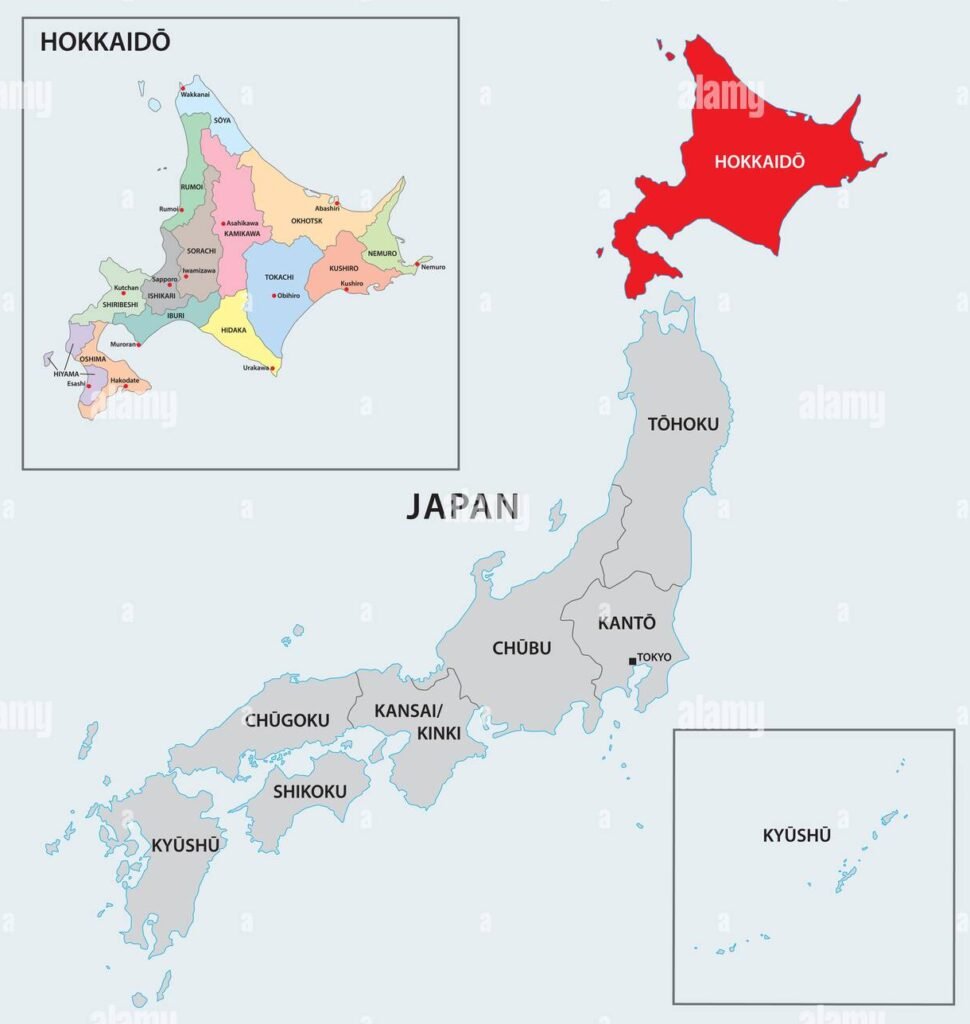
Below we illustrate some of the Hidden destinations we cover in Hokkaido, Japan and subsequently specific cultural insights linked to the Ainu culture.
The itineraries can integrate a strong naturalistic and thermal component, touching the main localities from the south to the north-eastern tip (Shiretoko) of the island.
You can follow a route that starts in the south (Hakodate), climbs towards Sapporo, enters the central mountains (Daisetsuzan) and finally moves towards the wild Shiretoko Peninsula and the crater lake area of the east, offering a complete mix of cities, volcanoes, onsen and Ainu culture.
In addition to organized tours, Hokkaido is also ideal for a Fly & Drive trip, which we tailor-design with our clients based on their specific interests.
HOKKAIDO
1. Southern Area (Hakodate and surroundings)
- Hakodate: Historic port city, first stop in Hokkaido (reachable by flight from Tokyo).
- Onuma Park
2. Central Volcanic Area (Shikotsu-Toya and Noboribetsu)
- Lake Toya: With a possible cruise to admire the volcanoes.
- Noboribetsu: Famous hot spring resort where you can visit the “Hell Valley” (Jigokudani).
- Lake Shikotsu
- Orofure Pass
- Ainu Culture Museum: Cultural stop dedicated to the native people.
3. Sapporo and Central-North
- Sapporo: As the capital of Hokkaido and home to Japan's famous beer, we always recommend a short visit to the city.
- Daisetsuzan National Park: Japan's largest wilderness area.
- Mount Asahidake: With a cable car ride and trekking up the island's highest volcano.
- Sounkyo: A spa town nestled in the gorges, an excellent place to stay overnight.
4. Eastern Area (Okhotsk and Lake Parks)
- Abashiri: City on the coast of the Sea of Okhotsk, famous for its prison and drift ice.
- Shiretoko National Park: A UNESCO World Heritage Peninsula, known for its unspoiled nature and the presence of brown bears.
- Kawayu Onsen: Spa town known for its acidic waters and proximity to Mount Iou.
5. The Three Eastern Lakes (Akan-Mashu)
- Lake Mashu: Famous for its crystal clear waters and fog.
- Lake Kussharo: The largest caldera lake in Japan.
- Lake Akan (Akankohan): Possible cruise on the lake, famous for its algae Marimo and possible visit to the Ainu village.
- Kushiro: Port city, useful for returning to Tokyo.
AINU
As travel planners, we don't want to take you to just "see" Hokkaido. We want to take you to listen to him. Here are some experiences we've selected to help you connect with Japan's native people, the Ainu:
1. Learn the alphabet on Upopoy
In Shiraoi, you'll find Upopoy, the Ainu National Museum. Don't imagine a dusty, silent museum. "Upopoy" means "singing in chorus." It's a vibrant place, where the first thing you do is sit and listen to traditional songs, or try playing the mukkuri, a small bamboo mouth harp that imitates the sounds of nature, from the wind in the reeds to the rain. It's the necessary starting point for understanding the grammar of this world.
2. Watch traditional dances
At the Cultural Exchange Hall, you can watch traditional dances Sinot, UNESCO heritage.
3. Walking with the Forest Keepers in Akan
The true heart of the experience is at Lake Akan. A vibrant community, the Akanko Ainu Kotan, lives here. With the "Anytime, Ainutime" programs, you won't be accompanied by tour guides, but by community members.
Imagine walking through an ancient forest not for trekking, but to learn to see. Your guide will show you that that particular tree isn't just wood, but the raw material for sacred vestments. That that plant is medicine. They'll teach you to ask the forest's permission before entering. It's a radical shift in perspective.
4. The Taste of Memory
Sitting down to dinner here is a ritual. In intimate restaurants like Poronno, you'll sample Ainu cuisine, delicate and deeply rooted in the land. Traditional local cooking classes are also available.
- Ohah: A warm and restorative soup of salmon or venison and wild greens.
- Ratashkep: A dish of stewed wild greens, roots, and beans.
5. The Magic of the Night
As the sun sets over Lake Akan, the storytelling continues. You can attend the Lost Kamuy, a show that combines ancient dance and modern digital art to tell the story of the now extinct Hokkaido wolf. Or you can participate in the Kamuy Lumina, a nighttime walk through the forest illuminated by magical projections, where the legend comes to life among the trees.
These are just some of the traditions that the Ainu have passed down to survive with ingenuity in a frozen land made hospitable by the dance with nature.
Traveling to these lands means restoring dignity to a history that wanted to be erased.
We at Lechuguita are ready to accompany you to the threshold of this world. The rest of the story, the most intimate and personal, will be written by you, step by step, in the sacred silence of the northern forests.
A hug from Antonella and Ludovico Lechuguita