

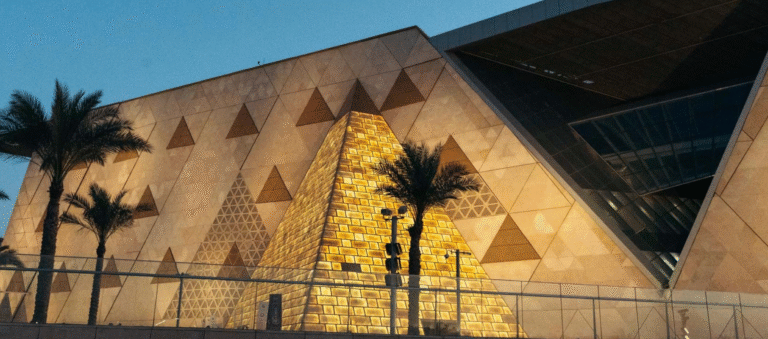
After more than three decades of waiting, delays, and a colossal investment exceeding $1 billion, the Grand Egyptian Museum (GEM) is revealed to the world.1 Located in the shadow of the pyramids of Giza, this is not just a museum, but a cultural, economic and political statement.2 It is the largest museum in the world dedicated to a single civilization and represents a strategic bet on Egypt's future.3
The opening is a global event orchestrated in meticulous stages. On November 1, 2025, a Grand Opening ceremony was attended by world leaders, monarchs, and heads of state, an event of such national significance that it was declared a public holiday in Egypt.2 But for the public, the crucial moment is the November 4, 2025, date of full opening to the public.3
This inauguration follows a “soft launch” that began in 2024, which allowed operations to be tested and limited access to certain areas.4 However, to orchestrate the grand finale, the museum was completely closed to the public from October 15 to November 3, 2025.3 This closure, shrouded in secrecy 2, it was not just logistical preparation; it was a national security operation to prepare the most priceless treasures, including Tutankhamun's complete collection, for their unveiling to the world.5
The Birth of a Giant: A 30-Year, Billion-Dollar Saga
The GEM's journey is a modern odyssey. The idea was born over 32 years ago, and the 470,000-square-meter (117-acre) site was awarded in 1992.1 In 2003, after an international competition that attracted 1,550 entries from 83 countries, the vision of Irish architecture firm Heneghan Peng was chosen.1
Construction, which began in 2005, was originally scheduled for completion in 2010.1 However, the project was overtaken by history. A series of cataclysmic events, including global financial crises, the tumultuous Egyptian political uprising of 2011 (the Arab Spring), the paralysis of the COVID-19 pandemic, and subsequent regional conflicts, halted construction for years.1
The fact that the project survived the fall of a government and a decade of profound economic instability demonstrates that the GEM has always been considered a project of national strategic importance, cutting across any political regime.2 It is a symbol of resilience.
This resilience came at a cost. The initial estimated budget of $500 million more than doubled, exceeding 1 billion dollars.1
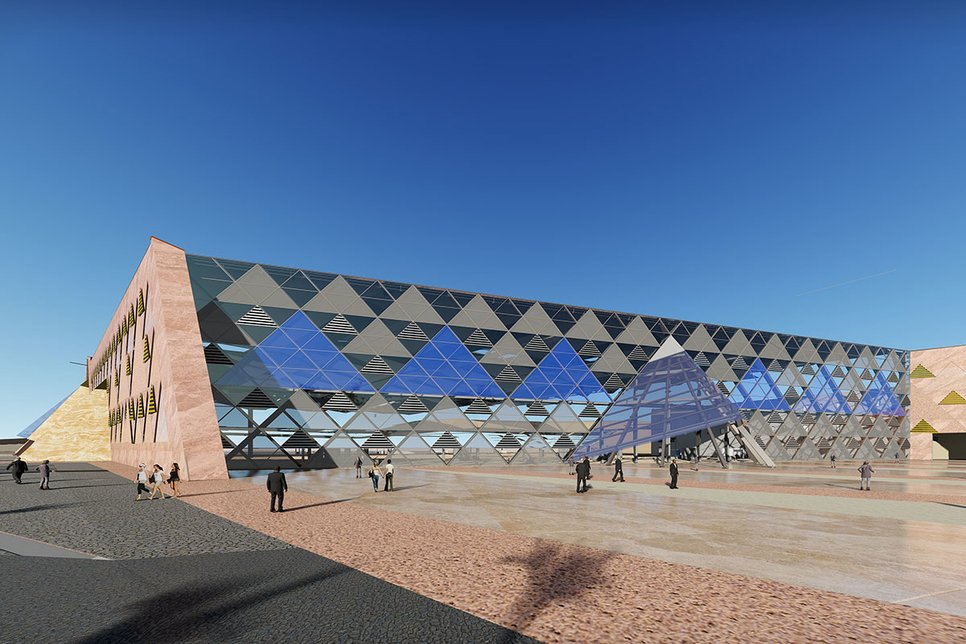
Architecture as Dialogue: Heneghan Peng's Homage to the Pyramids
The GEM is an architectural masterpiece designed not to dominate, but to interact with its eternal neighbors. Located just a mile (about 1.6 km) from the pyramids, the building itself is a tribute.1
Its distinctive feature is a triangular shape and a towering glass facade.1 The design is not arbitrary: the structure “radiates” from the plateau, with its walls aligning perfectly with the positions of the three main pyramids.1 The most significant design decision is an act of profound respect: the museum's ceilings and sloping lines follow the same sight lines as the pyramids, but were deliberately designed to do not exceed the height of the ancient structures.1 The architecture of the GEM is an act of submission to the past; it stands as a modern propylaeum (monumental entrance) that serves the Giza plateau, not as a competitor.
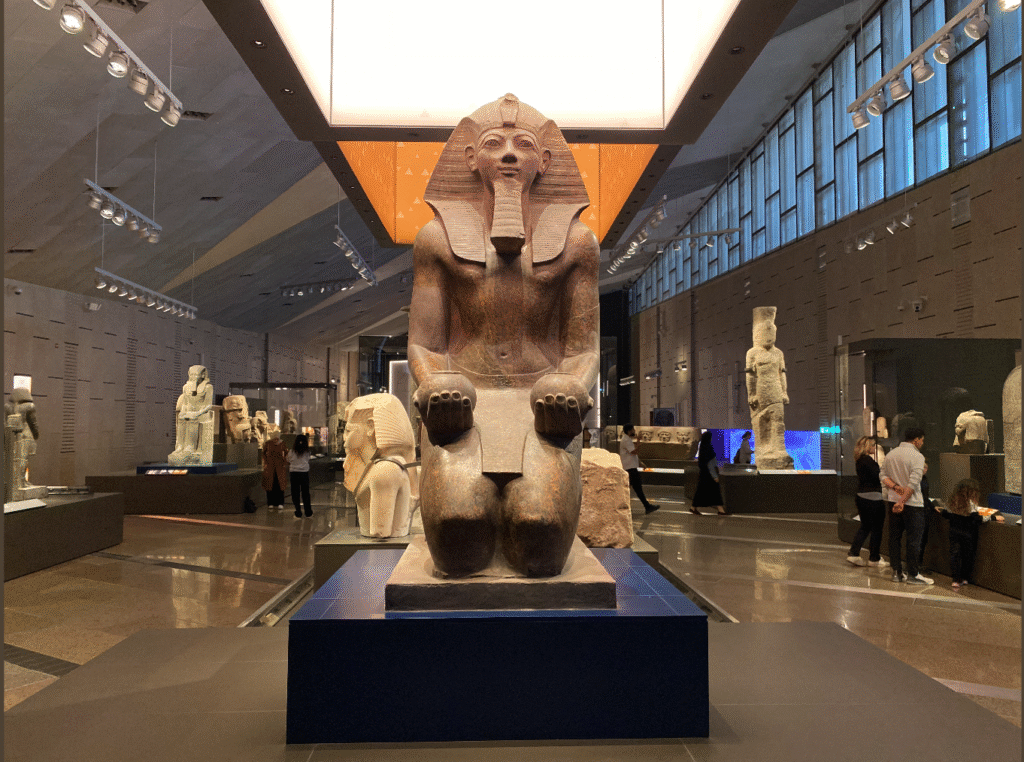
This sense of reverence is designed into the visitor's experience itself. One doesn't simply enter a gallery. One first enters the "Grand Hall," a cavernous space flooded with natural light that houses the colossal statue of Ramesses II.1 From there, the visitor is forced to make a physical and ritualistic ascent up the "Grand Stairs." This imposing staircase is lined with over 70 "gigantic" statues of Egyptian kings and queens.5 This path is not just logistical; it is a dromos (processional avenue) modern, designed to induce awe and force the visitor to perceive the monumental scale of Egyptian civilization before even seeing the smaller and more delicate artifacts.
Moving Eternity: The Logistics Firms Behind the Scenes of GEM
The creation of the GEM required two of the most complex and audacious engineering and conservation operations in modern history, responding to the challenge of moving the immeasurable.
The Journey of the Colossus: Ramses II
For decades, the 11-meter-high, 83-ton, 3,200-year-old colossus of Ramses II sat smothered in Cairo’s chaotic Ramses Square, eroded by “traffic fumes and congestion.”.7 Its first move in 2006 was a rescue operation. After testing the route with a replica, the colossus, wrapped in foam rubber, was transported upright for 10 hours to the Giza plateau.9 In 2018, it made its final journey: a high-precision 400-meter move to its place of honor in the GEM atrium, the first thing visitors see.1
The Pharaoh's Ship: Khufu's Solar Boat
An even more delicate undertaking was moving Khufu's Solar Boat. At 4,600 years old, it is the "largest and oldest wooden artifact" in the world.10 At 42 meters long and weighing 20 tons, this ritual vessel is incredibly fragile.10
In August 2021, the boat embarked on a journey of over 7 kilometers from its old museum at the foot of the Great Pyramid to the new “Khufu's Boats Museum” (included in the GEM ticket).3 It was sealed in a customized metal container, equipped with sensors to control “humidity and temperature” and protected by “special foams”.10 The entire structure was loaded onto a Belgian remote-controlled vehicle, designed to minimize vibrations.
These two operations highlight the museum's double challenge: the relocation of Ramses was a triumph of heavy-lift engineering, while that of Khufu was a masterpiece of conservation science.
Table: The Two Titanic Enterprises of the GEM
| Characteristic | Colossus of Ramses II | Khufu's Solar Boat |
| Finding | Stone statue | Wooden artifact |
| Age | ~3,200 years [7] | ~4,600 years 10 |
| Dimensions | 83 tons [7] | 42 meters, 20 tons 10 |
| Transfer | 2006 (on the plain) / 2018 (on the atrium) 9 | August 2021 10 |
| Distance | ~400m (final displacement) 9 | >7 kilometers 10 |
| Key Challenge | Immense weight, vertical stability 9 | Extreme fragility, vibration control, climate 10 |
| Final Position | Grand Hall (Atrium) 5 | Khufu's Boats Museum [3] |
A Never-Seen Treasure: Tutankhamun's Entire Collection and the 12 Galleries
The GEM houses a staggering collection of over 50,000 artifacts 4, but its beating heart is the Tutankhamun Galleries. For the first time in history, the’entire funeral trousseau of over 5,000 objects found in the tomb of the boy king will be displayed together.5
This is a curated event of historic significance. For a century, the treasure was fragmented: the most famous masterpieces, such as Tutankhamun's Death Mask, were displayed in the old, packed Egyptian Museum in Tahrir Square, while thousands of other objects lay in storage.4 The GEM finally reunites the discovery. The Mask itself was one of the last items to be transferred, ready for the grand opening.5
This reunification allows the museum to move from a "museum of objects" to a "museum of narratives." The 12 main galleries, spanning 24,000 square meters, are organized by era and theme, covering the entire history of Egypt, from the predynastic period to the Greco-Roman era of Cleopatra and Alexander the Great.4
Pharaoh Meets Generation Z: Immersive Technology and Mixed Reality
The GEM isn't just a custodian of the past; it's a portal to the future. The museum's leadership has adopted a radical technology strategy. As CEO Ahmed Ghoneim stated, the museum "uses the language Gen Z uses," prioritizing interactive technology over "traditional labels.".4
The result is a revolutionary Mixed Reality (MR) and Augmented Reality (AR) experience, the first of its kind in Egypt.11 Visitors can use “smart headsets” that blend the real world with digital enhancements.11 This MR technology allows you to superimpose holographic images, audio clips, and explanatory videos directly onto physical artifacts.11
Instead of reading a label, visitors can see the artifacts “tell their stories.”.12 In an experience narrated by Egyptian superstar Ahmed Helmy, “icons like Ramses tell their own stories.”.12
This technology isn't a gadget, but a powerful curation tool. Based on 3D laser scans of artifacts, the system allows for the "digital reconstruction of lost archaeological sites.".11 A visitor looking at a statue can, through the visor, see it recontextualized within the temple from which it was removed centuries ago.
Transforming the visit into an 'adventure in the time of the pharaohs” 11, the GEM is “gamifying” history. It is a conscious bet that interactivity 13 It is the key to remaining relevant and financially sustainable for future generations.
Betting on the Future: The Role of GEM in the Egyptian Economy
Behind its cultural splendor, the Grand Egyptian Museum is a cornerstone of a national economic strategy. Egypt hopes the $1 billion museum will "revitalize its economy and struggling tourism sector.".2 It is one of the “megaprojects” supported by President Abdel Fattah el-Sisi to stabilize the nation.2
The numbers are clear: the goal of the GEM is to attract 5 million visitors per year.1 This is part of a broader national plan to reach 30 million tourists per year by 2032.2 For an economy that has needed “repeated bailouts,” tourism is not a luxury: it provides “much-needed foreign currency” to pay for “crucial imports like fuel and grain.”.2 In this context, GEM is not a discretionary expense, but a strategic investment in critical infrastructure that generates hard currency.
To support this vision, an entire tourism ecosystem has been created. A new metro station has sprung up around the museum. 2 and the new Sphinx International Airport, located just 40 minutes away.2 Additionally, a new “walkway” or “bridge” directly connects the museum to the Giza Plateau, allowing tourists to travel on foot or by electric vehicle between the GEM and the pyramids.2
This infrastructure radically transforms the Giza experience. What was traditionally a half-day visit is now a hub Unified tourism. Visitors can land at the new airport, spend a full day at the GEM, and a second day exploring the pyramids, all without leaving the area. This turns a four-hour visit into a two-day stay, exponentially multiplying tourist spending and anchoring Egypt's economic future in its glorious past.
Discover our complete travel advice to book your next trip to Egypt and get ready to live an unforgettable experience.
And as always, a hug from Lechuguita!
#GrandEgyptianMuseum #GEM #Egypt #Shistory #Culture #Architecture #Landmark
Bibliography
- The Grand Egyptian Museum has grand opening after 3 decades and …, accessed on November 2, 2025, https://www.cbsnews.com/news/grand-egyptian-museum-opening/
- Egypt unveils Grand Egyptian Museum dedicated to its ancient …, accessed on November 2, 2025, https://www.aljazeera.com/news/2025/11/1/egypt-unveils-grand-egyptian-museum-dedicated-to-its-ancient-civilisation
- Grand Egyptian Museum, accessed on November 2, 2025, https://www.visit-gem.com/en/home
- Egypt's vast $1bn museum to open in Cairo after two-decade build …, accessed November 2, 2025, https://www.theguardian.com/world/2025/oct/31/egypts-vast-1bn-museum-to-open-in-cairo-after-two-decade-build
- Grand Egyptian Museum Opening November 4, 2025 (closed Oct 15 …, accessed on November 2, 2025, https://www.egyptadventurestravel.com/blog/grand-egyptian-museum-opening-november-4-2025
- Grand Egyptian Museum, accessed on November 2, 2025, https://visit-gem.com/
- Grand Egyptian Museum | grand opening | blooloop, accessed on November 2, 2025, https://blooloop.com/grand-egyptian-museum-opens/
- The Removal of Ramses II Statue – Dr. Zahi Hawass – The Plateau, accessed November 2, 2025, https://guardians.net/hawass/news/removal_of_ramses_ii_statue.htm
- Statue of Ramesses II – Wikipedia, accessed November 2, 2025, https://en.wikipedia.org/wiki/Statue_of_Ramesses_II
- Egypt, Cheops' "solar boat" transferred to a new museum – foglieviaggi, accessed on November 2, 2025, https://www.foglieviaggi.cloud/blog/egitto-trasferita-in-un-nuovo-museo-la-barca-solare-di-cheope
- Augmented reality transforms a visit to the Grand Egyptian Museum into an adventure in the time of the pharaohs – Follow ICT, accessed November 2, 2025, https://followict.news/en/augmented-reality-transforms-a-visit-to-the-grand-egyptian-museum-into-an-adventure-in-the-time-of-the-pharaohs/
- WATCH: GEM Lets Artefacts Do the Talking in Mixed Reality Experience – SceneNow, accessed November 2, 2025, https://scenenow.com/ArtsAndCulture/WATCH-GEM-Lets-Artefacts-Do-the-Talking-in-Mixed-Reality-Experience
- Using Modern Technologies in the Museums' Exhibitions: The Grand Egyptian Museum as a Case Study – International Journal of Heritage, Tourism and Hospitality, accessed November 2, 2025, https://ijhth.journals.ekb.eg/article_299549.html