

Where threads tell life
In southwest China, amidst mist-shrouded mountains and rice terraces suspended in greenery, lies Guizhou, one of the country's most authentic and mysterious regions. Far from the beaten tourist trail, time seems to pass more slowly. In the Miao and Dong villages, the days begin with the crowing of roosters and follow the rhythm of the loom.
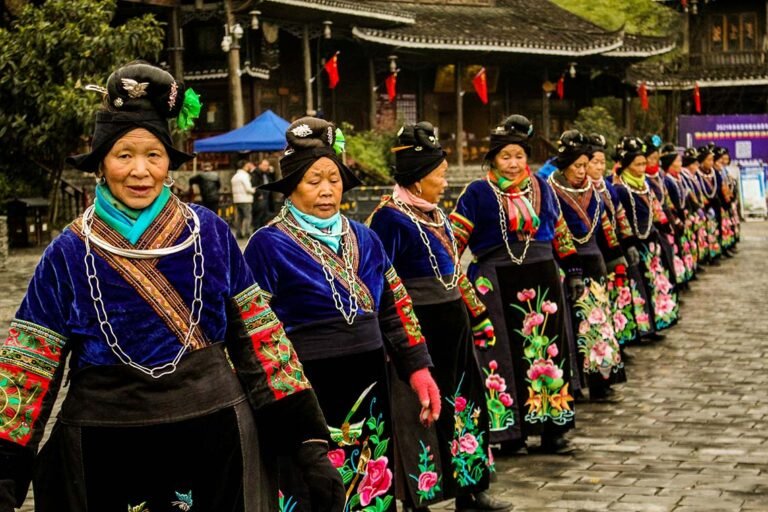
In these tea-scented wooden houses, Miao women continue to weave their story. Every move of the needle and every twist of thread becomes a reminder of who they are and where they come from.
Who are the Miao and the Dong: the roots of an identity
The Miao are one of China's oldest and largest ethnic minorities. Their origins date back over two thousand years and are intertwined with legends of migrations and sacred mountains. They live primarily in the provinces of Guizhou, Yunnan, and Guangxi.
The Dong, renowned for their polyphonic chanting and wooden architecture, share a deep connection with nature and community. Both ethnic groups have developed a rich heritage of manual arts, where weaving, dyeing, and embroidery become symbolic languages that endure through time.
Embroidering to Remember: The Hidden Language of Symbols
For Miao women, embroidery is more than just ornamentation: it's a form of writing. Geometric patterns and mythical figures tell stories of ancestors, lost loves, battles, and births.
Each embroidery is a silent text. Butterflies recall the creator goddess, dragons represent life force, fish prosperity, while the lotus flower evokes purity. The colors are symbolic: red for luck, blue for protection, white for purification.
A traditional dress can take over a year to make and is kept as a family treasure.
Thread as a feminine and spiritual legacy
Embroidery is transmitting memories. Girls learn by watching their mothers and grandmothers. Every stitch is a lesson in patience, every mistake a lesson. In a context where the written word was reserved for men, embroidery became the voice of women. It is an intimate language, capable of expressing emotions, dreams, and desires.
Many Miao craftswomen say that embroidery “is not done with the hands, but with the heart.”.
Between tradition and modernity: a silent rebirth
Today, many traditions are at risk of disappearing, but local cooperatives and UNESCO projects are training new generations of artisans. Chinese and international designers collaborate with local artisans, creating ethical and contemporary fashion that renews tradition rather than erasing it.
Traveling through the Villages of Guizhou: A Practical and Evocative Guide
How to get there
Fly to Guiyang, the capital of Guizhou, connected to Beijing, Shanghai, and Chengdu. From there, a fast train takes you to Kaili, an ideal starting point for exploring the Miao region.
Where to go
- Xijiang Qianhu Miao Village: The largest Miao village in the world.
- Zhaoxing Dong Village: Famous for its drum towers and polyphonic singing.
- Langde and Leishan: perfect for watching the embroiderers at work.
What to do
- Visit a Miao embroidery workshop
- Join the Miao New Year (October-November), when costumes explode with color and dance.
- Explore Kaili's local markets for fabrics, natural dyes, and silver jewelry.
Best time
Spring (April-June) and autumn (September-November) to enjoy the mild climate and golden landscapes.
A journey that sews the soul
Among the rice fields of Guizhou, time doesn't pass: it weaves. Miao embroidery is not just art, but a living memory that unites generations. Every thread unites, every color tells a story. Those seeking authenticity will discover a China sewn by hand, teaching that true beauty lies in the details.
“And perhaps, in a village suspended in the fog, between the scent of tea and the sound of a needle, one can still feel the ancient heartbeat of a culture that has never stopped telling its story.”